
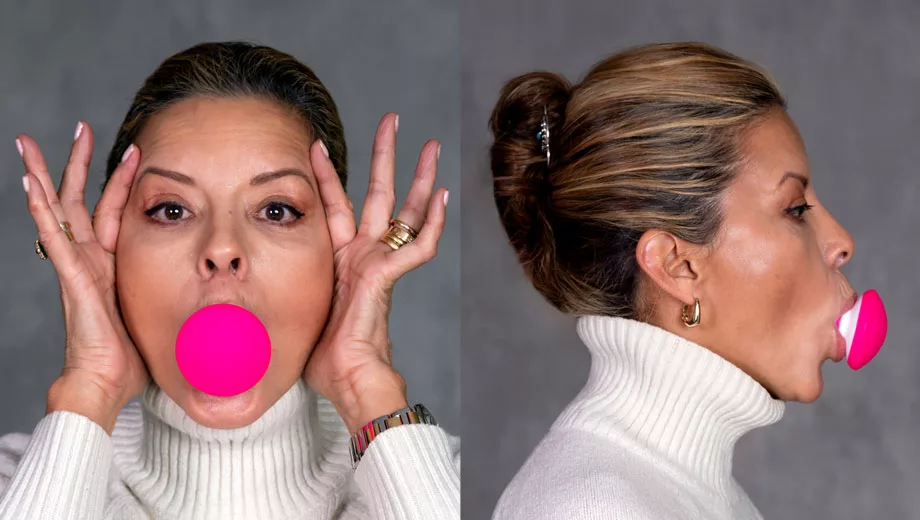
Understanding them, moving them, and learning to release tension in them can help you maintain a more alert, balanced, and well-cared-for face.
When we think about exercising the body, we immediately picture the legs, arms, abdomen, or back. We know that active muscles help us maintain strength, posture, and mobility. However, we rarely remember that the face is also made up of a complex network of muscles that work all day long.
We use them to speak, smile, close our eyes, frown, kiss, chew, and express virtually all of our emotions. Even when we’re silent, our face continues to communicate.
These muscles aren’t just involved in facial expressions. They’re also related to jaw mobility, head and neck posture, the tension we accumulate, and the way facial tissues are supported and move.
That’s why understanding facial anatomy changes the way we take care of ourselves.
It’s not about striving for a motionless face or fighting every wrinkle. It’s about understanding which muscles need to be activated, which need to be relaxed, and how we can support our skin, neck, and facial expressions with more mindful habits.
Welcome to the fascinating world of facial anatomy.
The Face Also Has Muscles
The muscles of the face are different from many of the muscles in the rest of the body.
While the muscles of the legs or arms are usually inserted between bony structures to produce movement, a large part of the facial expression muscles connect directly to the skin. This characteristic allows a very small contraction to raise an eyebrow, close the eyelids, modify the corners of the lips, or completely transform our expression.
The face does not function as a set of independent parts. Every gesture requires precise coordination between different muscles, the jaw, the neck, soft tissues, and the nervous system.
For example, a natural smile does not depend solely on the mouth. The muscles of the cheeks, lips, and, when the smile is genuine, the area around the eyes are also involved.
Similarly, an expression of concern can involve the space between the eyebrows, the forehead, the eyelids, and jaw tension.
Understanding these relationships helps us move beyond the idea that facial care consists solely of applying cream. The skin is essential, but it’s part of a much larger structure.
Anatomy of the Muscles of the Head and Face
We can organize these muscles into three main groups: the muscles of mastication, the muscles of facial expression, and the muscles of the neck and scalp that influence posture and facial balance.
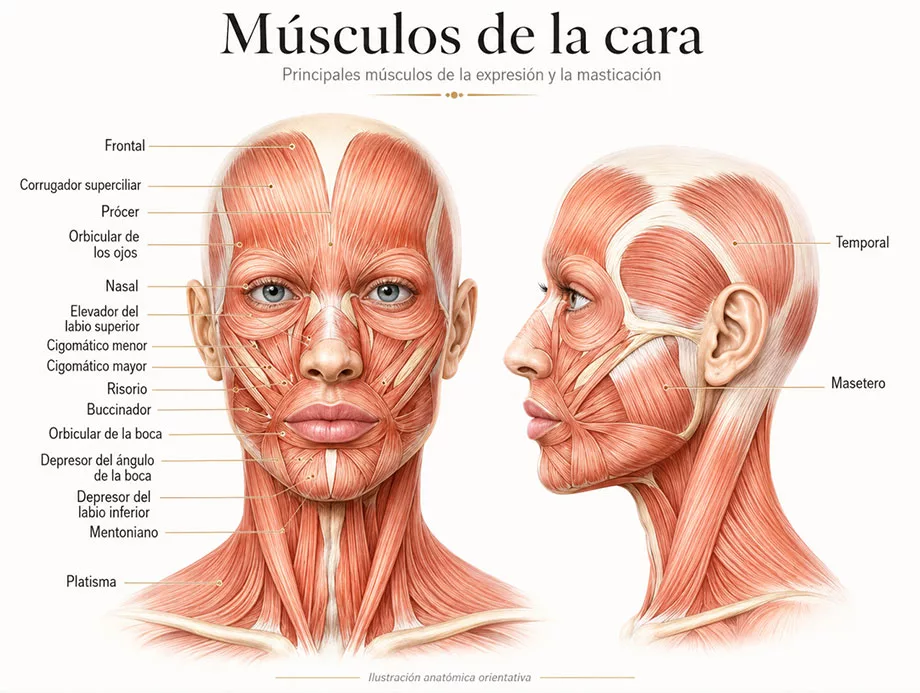
1. Muscles of Mastication
These muscles allow you to open, close, and move your jaw. They are essential for chewing food, speaking clearly, and maintaining the stability of the temporomandibular joint.
Masseter
Located on the side of the jaw, it is one of the most powerful masticatory muscles and is primarily involved in closing the mouth.
It can accumulate a lot of tension in people who clench their teeth during the day or suffer from nighttime bruxism. When it remains overactive, you may notice a stiff jaw, discomfort upon waking, sensitivity to touch in the area, or a wider appearance in the lower third of the face.
Temporalis
It extends in a fan shape across the temples and is involved in closing and moving the jaw.
Tension in the temporalis muscle can be accompanied by pressure in the temples, a feeling of heaviness in the head, or discomfort related to teeth clenching.
Medial and Lateral Pterygoids
These are deeper muscles, located within the mandibular region. They allow complex movements, such as moving the jaw sideways and forward.
Due to their location, they should not be manipulated deeply without the guidance of a qualified professional.
These four muscles work in a coordinated manner. When there is a significant alteration in their function, pain, limited mouth opening, clicking, or discomfort in the temporomandibular joint may occur.
Muscles of Facial Expression
These are the great interpreters of our emotions. They are located very close to the surface, and many of them insert directly into the skin.
Frontalis
It occupies the front part of the forehead and raises the eyebrows.
When we constantly contract it to open our eyes wider or compensate for drooping eyebrows, horizontal lines can appear on the forehead. This doesn’t mean we should stop making facial expressions, but rather learn to recognize when we are maintaining unnecessary tension.
Corrugator and Procerus
They participate in the frown between the eyebrows and in expressions associated with concentration, worry, or anger.
Repetitive use of this area can contribute to the appearance of vertical lines between the eyebrows. Breathing, relaxing the gaze, and gently massaging the area between the eyebrows can help raise awareness of this tension.
Orbicularis Oculi
It surrounds the eyelids and allows them to close. It also participates in a genuine smile and in protecting the eye.
It is a delicate muscle. Exercises and massages around the eyes should be performed without intense pressure and without pulling on the skin.
Zygomaticus Major and Minor
They raise the corners of the mouth and cheeks. They are fundamental to the smile and contribute to the expressiveness of the midface.
Good mobility in this area can provide a more open expression, but it’s not advisable to overexert it or create tension around the mouth.
Orbicularis Oris
It surrounds the lips and allows them to close, project, and perform movements such as kissing or pronouncing certain sounds.
Its mobility influences the expression of the mouth. Exercises should be performed precisely to avoid excessive compensation in the chin or neck.
Buccinator
It is located deep in the cheeks. It keeps food between the teeth during chewing and participates in actions such as blowing or sucking.
It should not be confused with the muscles that raise the cheeks. Its main function is related to the stability of the oral cavity.
Mentalis
It is located in the chin and raises the skin in this area. Some people contract it excessively when closing their lips, speaking, or performing certain facial exercises.
When small dimples or an “orange peel” texture appear on the chin while at rest, it may indicate an excessive activation that should be learned to relax.
Depressors of the Corners of the Mouth and Lower Lip
These muscles pull the mouth down and are involved in expressions of sadness, displeasure, or tension.
It is not necessary to intensely “strengthen” them. In many routines, it is more beneficial to improve overall coordination and prevent them from constantly dominating facial expressions.
Scalp, Neck, and Décolletage: The Structure We Must Not Forget
The face does not end at the jaw.
Head position, cervical tension, scalp mobility, and neck muscles influence the overall appearance of the face.
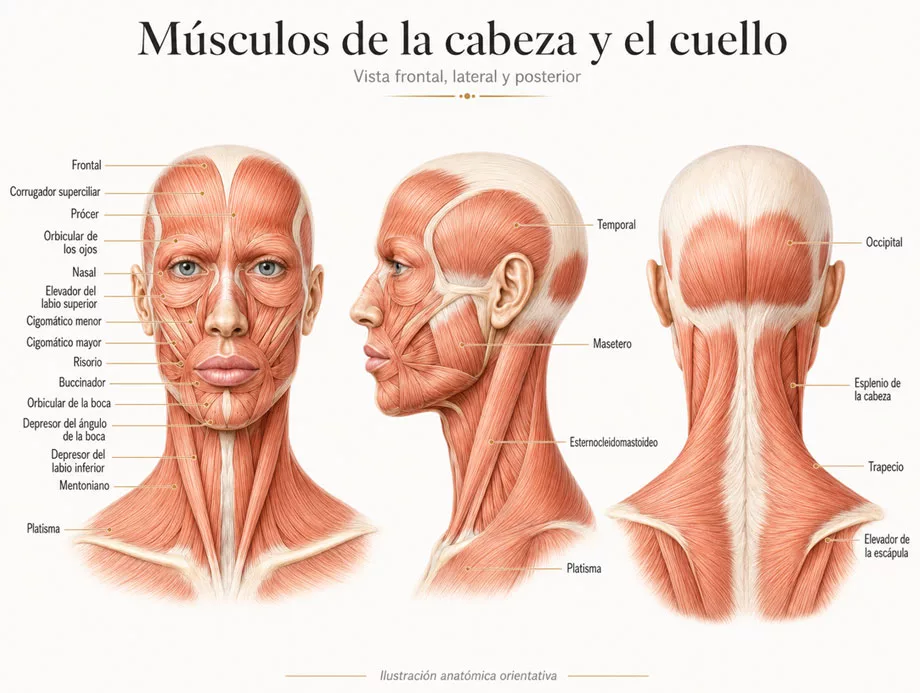
Occipitofrontalis
This muscle connects the forehead to the back of the skull via a broad tendinous structure. Scalp mobility and occipital tension can be related to a feeling of stiffness in the head.
Sternocleidomastoid
It runs along both sides of the neck and allows you to turn and tilt your head.
When we lean forward for many hours to look at our phones or computers, this muscle can become overloaded. Poor posture also changes how we hold our jaw and neck.
Platysma
It is a thin, superficial muscle sheet that extends from the upper chest to the jaw.
It is involved in certain movements of the lower third of the face and neck. Over time, it can lose coordination and develop more visible bands, but working on it is not simply a matter of performing strong contractions. Posture, breathing, cervical mobility, and jaw relaxation are all part of its care.
Upper Trapezius and Suboccipital Muscles
Although they are not facial muscles, they influence the position of the shoulders, neck, and head.
A hunched posture, with raised shoulders and a jutting chin, can convey tiredness and visually harden the expression. That’s why a complete facial routine should start with the body, not just the face.
Facial Aging Doesn’t Depend Solely on Muscles
Talking about facial exercises doesn’t mean that all facial aging is due to a loss of muscle tone.
Facial aging is a complex process involving the skin, facial fat, muscles, ligaments, fascia, and bone structure. The distribution of tissues also changes over the years, so no single technique can completely control the evolution of the face.
The Skin
Over time, its capacity for renewal, hydration, and elasticity decreases. Cumulative sun exposure, smoking, pollution, stress, and hormonal changes also influence its appearance.
Facial Fat
It doesn’t behave as a uniform layer. It’s distributed in compartments that can lose volume or shift, altering the cheeks, temples, and facial contour.
Ligaments and Fascia
They act as connecting and supporting elements. Over the years, their elasticity and their ability to hold tissues in position can change.
The Bone Structure
The skull also ages. Some areas lose volume or slightly alter their shape, affecting the support on which the tissues rest.
The Muscles
Muscles can change in volume, elasticity, coordination, and activity patterns. Some lose stimulation, while others remain overly contracted.
Therefore, facial care is not just about “toning” the face. The goal should be to improve awareness, mobility, and the balance between activation and relaxation.
Can Facial Exercises Rejuvenate the Face?
The answer requires caution.
Small studies have observed favorable changes after consistent facial exercise programs. In a 20-week pilot study with middle-aged women, evaluators observed an improvement in cheek fullness and a reduction in perceived age.

Another study using an oral exercise device found changes in the thickness of some muscles and in certain facial contour measurements after eight weeks of frequent use. Again, these are interesting results, but they don’t promise universal rejuvenation.
Therefore, facial exercises are important within a skincare routine, but they don’t replace rest, a proper diet, hydration, general physical exercise, or dermatological care when necessary.
The Most Realistic Benefits of Facial Exercises
- Increasing awareness of facial expressions and tension
- Improving the coordination of certain muscles
- Promoting a more open expression
- Supporting mobility of the face and neck
- Making facial care a consistent habit
The result depends on each person’s anatomy, age, consistency, technique, and tissue condition.
Not All Muscles Need Strengthening
This is one of the most important principles.
We know that a sore area doesn’t always need more strength. Sometimes it needs rest, mobility, or a correction of technique. The same is true for the face:
- The masseter may be excessively contracted.
- The area between the eyebrows may remain active for hours.
- The mentalis may strain to keep the lips closed.
- The neck can tense up to compensate for a poorly executed exercise.
The Five Actions of a Balanced Routine
- Observe
- Activate
- Mobilize
- Relax
- Gently drain
Doing many repetitions without control can lead to fatigue, jaw pain, or further compensatory movements. The quality of movement is more important than the quantity.
During a facial exercise, the rest of the face should remain relatively relaxed. If, while working the lips, we raise our shoulders, wrinkle our forehead, or tense our neck, we are probably using more force than necessary.
The mirror can become a learning tool, not to judge ourselves, but to observe how our face moves.
Facial Massage: Skin Care and Tension Release
Facial massage doesn’t strengthen muscles in the same way as resistance exercise, but it can complement your routine.
Gentle movements provide a feeling of relaxation, help you consciously explore different areas of the face, and can produce a temporary increase in cutaneous blood flow. A study using a facial roller found an immediate increase in skin circulation after a short session and changes in vascular response after several weeks of use.
This doesn’t mean that the massage eliminates toxins, erases wrinkles, or permanently reshapes the face.
Its value lies in the ritual, the contact, the relaxation, and the ability to work on the skin without harsh movements.
How Should Facial Massage Be Done?
- The pressure should be pleasant.
- Around the eyes and on the neck, it should be especially light.
- The product used must provide enough glide to avoid unnecessarily dragging the skin.
Rollers and tools can be enjoyable, but they are not essential. Clean hands and a gentle technique are sufficient.
Face & Neck: Cosmetics and Movement in a Single Ritual
Natural Beauty’s Face & Neck is an oil-based serum designed to complement facial massage, exercises, and yoga.
Its texture facilitates the glide of the fingers over the face, neck, and décolleté, avoiding work on dry skin. At the same time, it transforms the exercise into a sensory ritual that invites us to pause and dedicate a few minutes to our self-care.
It’s not necessary to apply an excessive amount. A few drops distributed between the hands and gently pressed onto clean skin are enough.
Then, we can perform upward and enveloping movements, always respecting the anatomy and avoiding intense friction.
The product does not replace muscle work, nor does exercise alone transform the skin. Both complement each other: cosmetics care for the surface, and massage helps us work on mobility, touch, and facial awareness.

Common Mistakes in Facial Exercises
Working on Dry Skin
Massage without gliding can be uncomfortable and cause friction. Use a suitable product and a moderate amount.
Confusing Tension with Tone
A stiff muscle isn’t necessarily strong. It may be fatigued, overworked, or poorly coordinated.
Expecting Immediate Results
As with any habit, changes require consistency. The first benefit is usually a greater awareness of facial expressions and tension, not a sudden aesthetic transformation.
Copying Routines Without Adapting Them
Not all faces need the same thing. Age, bite, posture, cosmetic procedures, and pre-existing discomfort should all be taken into account.


